
How Dangerous Are Tattoos?

In Germany, around eight million people are tattooed. Tattoos done by amateurs are pricked into the skin with needles; professional tattoo artists use tattoo machines. These implant the color pigments more densely into the skin and the color brilliance is much higher – but removal by laser is then considerably more difficult.
For black tones, India ink is usually used; for colored tattoos there are special color blends. Older inks contained metal salts such as chromium, manganese, mercury, and cobalt; nowadays predominantly industrially manufactured organic pigments are used. Permanent make-up colors are tattoo inks too: they contain iron oxide pigments and titanium dioxide for more natural shades such as white, brown, beige, and skin tones.
Tattoo inks are almost always color mixtures; around two-thirds of all inks contain titanium dioxide as a white brightener. The mixtures are not standardized, and to this day there is no legal declaration requirement for tattoo inks anywhere in the world. So no one who gets tattooed knows for certain what is being injected into their body to remain there permanently – while cosmetics, which only touch the skin’s surface, are strictly regulated.
Many ingredients of these color mixtures are carcinogenic and allergenic. After tattooing, immunological processes are frequently triggered. Particularly stubborn are allergic reactions with hardening, redness, and itching, including in connection with sun or tanning beds. In the worst case, the whole body is affected. People with psoriasis or sarcoidosis can develop inflammatory nodules directly along the tattooed lines.
Tattoo Removal – a Case Study
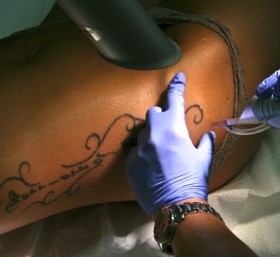
A young man talks to his tattoo artist:
Maik: Hey, I have a problem. You know I wanted to start my training with the police. Now they tell me that with this tattoo on my forearm I can forget it. Any idea how I can get rid of it?
Tattoo artist: Yeah, you can have it lasered off. You’ll have to go a few times, and the lasering hurts too. The laser heats the color pigments, which makes them explode. Part is ejected directly through the skin, part is carried away via the lymphatic system, and part your body absorbs again.
Maik: I’m not exactly thrilled about it hurting, though.
Tattoo artist: I’ll send you to a dermatologist. They put on a numbing cream that works in under foil for an hour, and they cool during and after. That makes it bearable.
Maik: And then it’s done?
Tattoo artist: Well, for a professional tattoo you have to figure on 8–15 appointments, always with four-week breaks in between. And red, green, and yellow aren’t so easy to laser away. Black usually goes well – but some colors turn brown during lasering and then they’re really stubborn.
Maik: And what do you do if it doesn’t come off completely?
Tattoo artist: Dermabrasion or cutting it out. But that leaves scars, because it goes deep.
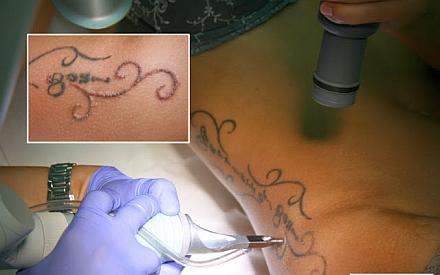
Red is the pigment that most frequently causes intolerance reactions. During laser treatment, the azo dyes it contains are split and nitroanilines are released – these are toxic and carcinogenic. Split color pigments can also trigger allergic reactions, which can be so massive that emergency medical treatment becomes necessary. Tattoos should therefore only be removed by a physician – not by so-called laser therapists, alternative practitioners, or briefly trained non-medical providers.
Various laser systems with different wavelengths are used for removal: some work better on colored tattoos, others better on black ones. Ideally, the practitioner has the entire spectrum available. When removing permanent make-up, a test laser treatment is essential: with iron oxide and titanium dioxide there is a risk of the color shifting to green, brown, or black. These shades sometimes no longer respond to further laser treatment – on the face, that is very distressing.
Interview
Question: Many tattooed people want to part with the sins of their youth. What is your experience with demand for tattoo removal?
Dr. Adler: For several years now, the trend has been toward health consciousness and natural aesthetics. Once the body has been brought into shape with fitness and a healthy diet, the old tattoo on the shoulder, upper arm, décolleté, or lower back suddenly bothers people. On aging skin, many tattoos no longer look good either: they fade and wrinkle. Many people also no longer want to carry toxic pigments that burden the body for decades. And it is human nature to change one’s taste over the course of a lifetime – some eventually hide their tattooed areas or, when looking for a partner, suffer from the message the motif sends. Since the technology has advanced rapidly, removal today is gentle, scar-free, and affordable. Especially with a powerful Q-switched Nd:YAG laser, the results are breathtakingly good compared to older systems.
Question: In your opinion, what makes good laser medicine?
Dr. Adler: Good quality requires good training and a high degree of responsibility – the laser technology plays as big a role as the practitioner’s know-how. Moles, for example, must not be lasered; a correctly established diagnosis is essential, and sometimes a tissue sample must first rule out malignancy. Important factors are the skin type, the type and age of the tattoo, whether it was done by a professional or an amateur, and which laser type is used. Only when wavelength, dosage, and exposure time fit together do you get an optimal result. In addition, the practitioner must be able to assess excessive skin reactions during the treatment itself and take countermeasures – for rare but possible severe allergic reactions, only medication-based treatment often helps. A cosmetician or lay therapist cannot provide that.
Question: How do I, as a patient, recognize a good laser practitioner?
Dr. Adler: The practitioner should have a range of different laser systems to choose from, in order to offer the right laser for each indication. Ask the doctor how often they have performed this treatment, and check whether all your questions are answered satisfactorily. Recommendations from other patients are helpful, too. A good laser practitioner advises you comprehensively, can estimate the duration of treatment, and explains what you yourself can contribute in aftercare to achieve the desired result.